5 Illusions and Paradoxes Explained
Published:
11.6.2025
Updated:
11.6.2025
Welcome to Paradox Museum Helsinki! We challenge your reality and perception while taking you on a wild ride. Our interactive Museum is filled with illusions and paradoxes that will make you question everything you thought you knew about the world. If you think you have seen it all, think again. From defying gravity to optical illusions, Paradox Museum Helsinki offers a one-of-a-kind experience that is sure to leave you amazed. In this article, we’ll explore some of the most famous and mind-bending illusions and paradoxes you will encounter at the Museum.
1. The Ames Room: The Illusion of Changing Size
The Ames Room is a visual masterpiece that has fascinated people since it was first created by Adelbert Ames in 1935. The story behind the Ames Room begins earlier, with a man named Hermann von Helmholtz. Hermann wondered in the late 19th century that could a room be distorted in a way that it still looked like a normal rectangular room. Ames took this idea a step further and created the first-ever Ames Room.
The Ames Room is built with a floor and ceiling at an angle. This creates forced perspective and tricks the eye into thinking both sides of the room are the same. The actual shape of the room is a trapezium which removes any proper scaling of object size. When you enter the room, it looks like the two people standing in opposite corners are in the same field of view. In reality one person is much closer than the other. This leads the brain to interpret the size of objects incorrectly, creating the dramatic disparity in size.
At Paradox Museum Helsinki’s Ames Room you’ll experience the mismatch between physical stimuli and perception. The room messes up your sense of sight and causes the brain to misinterpret what signals it is receiving. Fun fact: people who are familiar with the person in the room (like married couple) may experience the effect of the room more lightly. So, if you don’t see difference of size when there’s two persons in the room, it might totally normal.
What to do in the room:
Stand in the left corner of the room and have a friend stand in the right corner. Look at the screen inside the room. You can also switch places with your friend and see how it looks like from the screen. If you want, you can ask our staff to take a photo or video of you and your friend in the room.
What’s going on:
The shape of the room (trapezium) makes your brain interpret the distances and sizes of objects incorrectly. The room itself looks like a normal rectangular space from the marked viewpoint, which causes the persons change sizes when they move around the room.
2. Color Shadows: A Play with Primary Colors
The concept of colors begins with combinations. Primary colors – red, blue and yellow – are the building blocks of all other colors. Rest of the colors, like orange, green and purple are called secondary colors and they are made by mixing two primary colors. Tertiary colors result from mixing primary colors with secondary colors. But what happens when we use light instead of pigment to create colors?
Visible light, which is also known as white light, consists of all the colors of the rainbow, including violet, indigo, blue, green, yellow, orange and red. When light passes through a prism it is dispersed in to a spectrum of colors. You can see this principle in action in the Color Shadows room.
In the Paradox Museum Helsinki’s Color Shadow Room three spotlights (red, blue and green) shine on the same point creating white light. However, when you stand in front of one of the lights, the other two create shadows in colors like yellow, magenta and cyan. This happens because when you block one of the lights, the remaining two colors mix together to form different color.
What to do in the room:
Look at the wall inside the room. What color is it? Now look at the three spotlights on the opposite side. What colors are they? Stand in front of one of the spotlights and observe the colors of the shadows on the projection wall. You can even try how many different colors you get from the lights.
What’s going on?
When you block one light source the remaining two colors mix to form secondary colors in the shadow. This is a fascinating experiment in the way light and color interact and how our perception of color changes depending on what light is present.
3. The Mirror Maze: Lost in Reflections
Mazes have always intrigued people. The word “maze” dates back to the 13th century and comes from the English word meaning “delirium” or “delusion”. And that’s exactly what the Mirror Maze at Paradox Museum Helsinki does to your senses. It creates an environment filled with repeated patterns and infinite reflections that can confuse even the sharpest minds.
The Mirror Maze features a pattern of parallel mirrors that reflect and repeat the maze’s design creating the illusion of an endless corridors. The maze tricks your mind into thinking the space goes on forever and finding your way out becomes a thrilling challenge. Current speed record to walk through the Mirror Maze is held by our staff member and we don’t encourage our visitors to break it.
What to do in the room:
Step into the maze and try to find your way out. The maze might seem simple at first but the mirrors will confuse you when you step around the corner. Can you escape the infinite reflections? Don’t worry though. There’s only one way through our maze.
What’s going on?
The mirrors reflect each other’s images creating a seemingly endless space and corridors. These endless reflections make the maze hard to navigate. Your brain struggles to make sense of the repeating patterns and you end up disoriented and confused.
4. The Tilted Room: Balance is Key
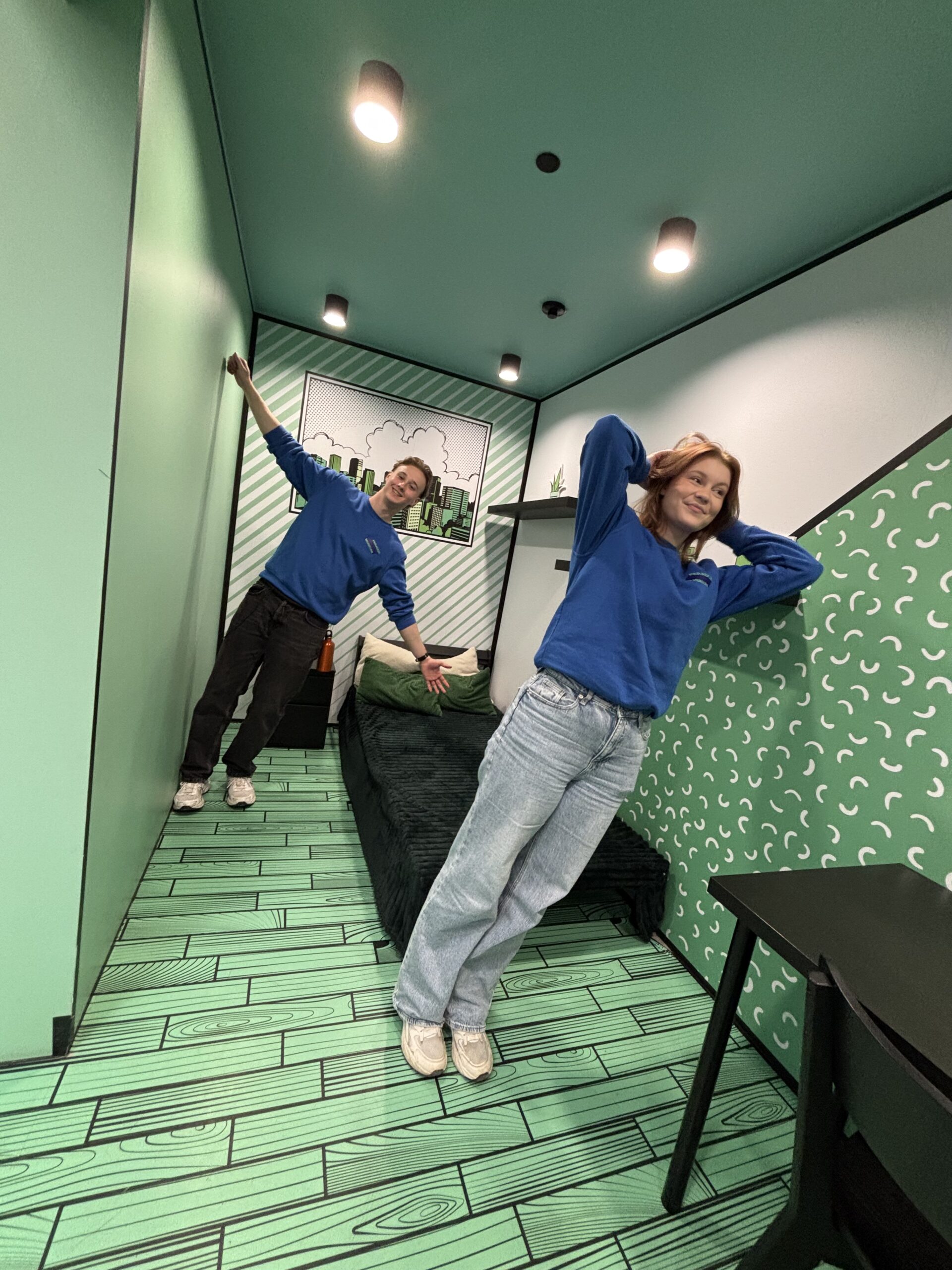
The Tilted Room at Paradox Museum Helsinki is a room designed to confuse your sense of balance. Sense of balance is primarily controlled by our visual and inner ear systems. Normally, our eyes and the vestibular system in our inner ear work together to tell our brain whether we are standing straight or leaning. But in the Tilted Room this system is mixed up.
The room is tilted at an extreme angle that leads mixed signals from your eyes and inner ear and this gets your brain mixed up. This room is an excellent demonstration of how our sensory organs like eyes, inner ear and muscles work together to help us maintain balance. When one of those signals is incorrect, it causes confusion and walking or standing straight becomes hard.
What to do in the room:
Try walking, sitting, or lying down in the room. Does it feel harder than it looks? Stand in front of the mirror and check your posture. Take a picture as if it were a normal room and see how strange it looks!
What’s going on:
The tilted floor and walls send incorrect visual signals to your brain. This causes your brain to misinterpret your position and feel disoriented. This illusion makes a great example of how the information our senses receive can be used to throw us off balance.
5. The Following Eyes: The Eerie Illusion of Movement
The Following Eyes illusion at Paradox Museum Helsinki is a spooky optical paradox that plays with your brain’s ability to interpret movement. When you move around in front of the library shelves, it appears as though the eyes are following you. The illusion occurs because your brain processes the eyes in the painting as if they were real eyes on a face.
The effect is achieved by the unique convex shape of the eyes in the library shelves. Concave mirrors make us look taller and convex mirrors make us look smaller. The Following Eyes exhibit works on the same principle. When you move, your brain perceives the eyes as following your movement. It’s a disorienting effect that will make you question if you’re being watched.
What to do in the room:
Stand in front of the library shelves and move around. You can even try to circle around the table. Do the eyes seem to follow you? Try looking closely and see if you can detect how the illusion works.
What’s going on?
The convex shape of the eyes (bulging shape) tricks your brain into thinking that the eyes are following your movements. This is a fun example of how depth perception and visual cues can make us believe that something is moving when it really isn’t.
Conclusion: A Word of Wonder Awaits
Paradox Museum Helsinki is an exciting destination for anyone looking to experience the unexpected and explore the mysteries of perception. With exhibits like the Ames Room, Color Shadows, Mirror Maze, Tilted Room and Following Eyes, the museum offers a one-of-a-kind experience that challenges both your mind and your senses. Whether you’re interested in the science part of our illusions and paradoxes or someone looking for a fun adventure, the mind-bending halls or Paradox Museum Helsinki are sure to leave you amaze and questioning the world around you. So, what’s taking you so long? Book your tickets already!